

Databrewery Marketplace: For Frontier AI Labs data
A 0→1 marketplace design that turned Databrewery's proprietary dataset catalogue into a self-serve platform, built, shipped, and live in 30 days.
View Live Platform
Role
UX Designer
Industry
B2B, SaaS, AI Infrastructure
Customer
Travus AI, Fano Lab & Other AI Labs
“More than a marketplace design this was building the operational backbone of how AI teams discover, evaluate, and request high-quality datasets.”
How a Sales Team Was Losing Deals to Their Own Inbox
Before the marketplace, Databrewery's entire dataset distribution ran through email attachments and Excel files. A client would request samples, a sales rep would manually curate a spreadsheet, send it over, and then wait. If the client needed a different language, a different audio type, or a wider sample set, the whole cycle restarted.
For frontier AI labs who move fast, this friction was fatal. A 48-hour email loop in a procurement decision means a competitor with a cleaner demo wins the deal. Trust degraded. Deals stalled. The team was spending more time on logistics than on selling.

I Didn't Just Design Screens. I Defined What to Build.
My scope on this project went beyond UI delivery. I owned the end-to-end design, from the initial information architecture to the live product handoff, while also driving key strategic decisions that shaped the product direction.
I led the proposal to build a standalone marketplace rather than integrate into the legacy platform. I defined the V1 feature scope using a Good / Better / Best framework. I conducted client interviews with frontier AI labs to extract the nonnegotiable product requirements. I designed the full component library, the dataset discovery flows, and the sample preview experience, and worked directly with engineering to ship it inside 30 days.
This was a project where design decisions had direct commercial consequences. Every call I made had to balance user trust, sales conversion, and build speed.
The Real Problem Wasn't Distribution. It Was Trust.
Frontier AI labs don't just buy data, they stake their model quality on it. The old email process gave them no way to evaluate what they were getting before committing. No preview. No metadata. Just a spreadsheet and a promise.
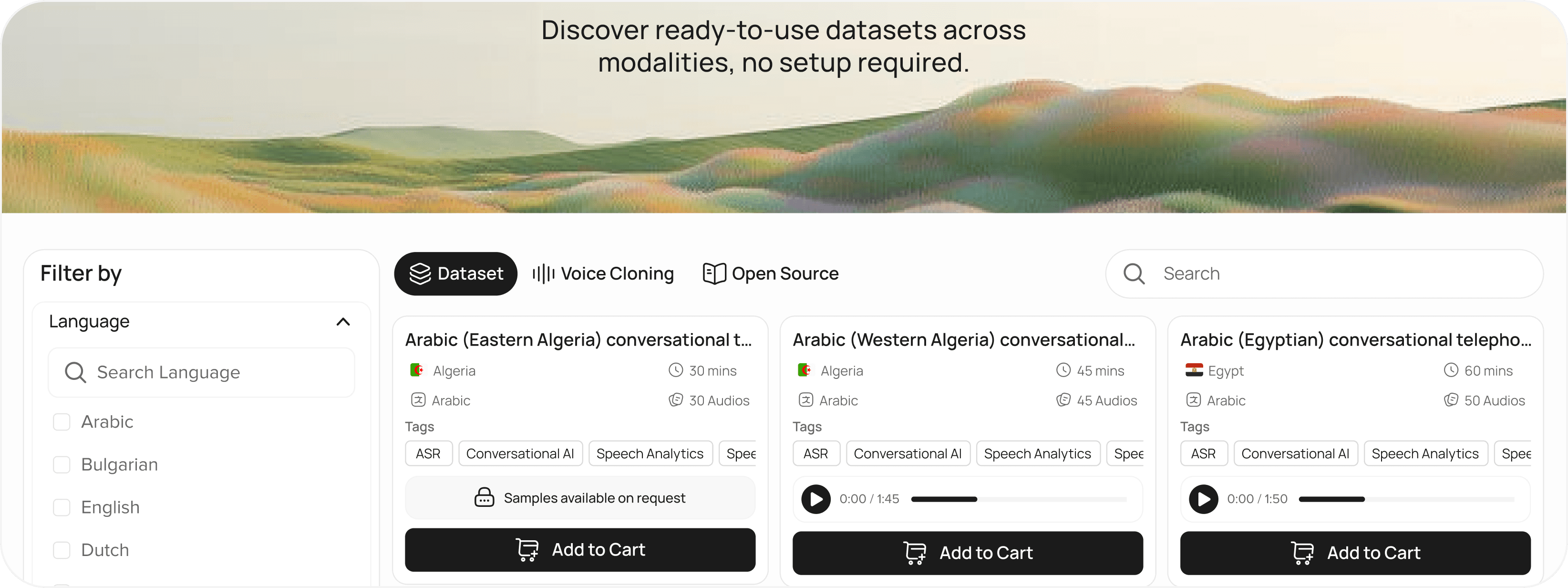
The design challenge was precise: build a platform that makes 40+ proprietary datasets discoverable, evaluable, and requestable, without a login wall, while creating enough transparency to earn trust from the most technical buyers in the industry.
Conversations That Changed the Entire Roadmap
Before touching Figma, I interviewed our existing frontier AI lab clients. I wanted to understand how they actually search for training data, not how we assumed they did.
What came back was a clear, structured search pattern, they filter first by dataset type, then by language and country, then by use case. But the single biggest finding was this, every lab wanted to hear or see a sample before committing. Not a spec sheet. Not a metadata table. An actual audio clip they could evaluate with their own ears.
When I cross-referenced this against competitors, Shaip, Humyn Labs, DataOcean AI, Nexdata, one gap was prominent, most of them didn’t offered in-platform sample previews. Every major marketplace required a sales conversation to get to a sample. That gap became our sharpest competitive advantage and the anchor of the V1 design.
“We didn't rebuild a marketplace from scratch. We filled the one gap every existing platform had left open”
We Almost Built the Wrong Thing. Here's How We Caught It.
Our first direction was logical on paper, integrate the dataset marketplace into Databrewery's existing platform. We already had a design system, existing components, and a live product. Reusing them felt fast and safe.
When I was mapping the user flow for a first-time visitor, a researcher at a frontier AI lab who had just heard about Databrewery from a colleague. The logic was circular, and the login wall was the block.
I went back to my research. Looking at it now with fresh eyes, the pattern was obvious, every competitor listed their datasets on a separate, publicly accessible page. No login. No friction. Just open access.
I hadn't flagged it earlier because we hadn't been thinking about trust architecture. Now it was the only thing I could see.
I documented everything, the circular flow, the competitor findings, and the specific drop-off risk we were building toward. I brought it to leadership as a structured problem with a clear recommendation, give the marketplace its own identity.
I proposed a separate, standalone web platform. No login. Its own brand. Its own URL. Audio datasets only at launch, with a clean path to expand.
The engineering team confirmed they could build a fresh site within the same 30-day window. Leadership aligned. We threw out two days of work and restarted on the right foundation. Four weeks later, the standalone marketplace was live, and the first labs to use it didn't have to create an account to do it.
"The logic was circular, and the login wall was the block. We threw out two days of work and restarted on the right foundation."
Every Screen Solves a Specific Trust Problem
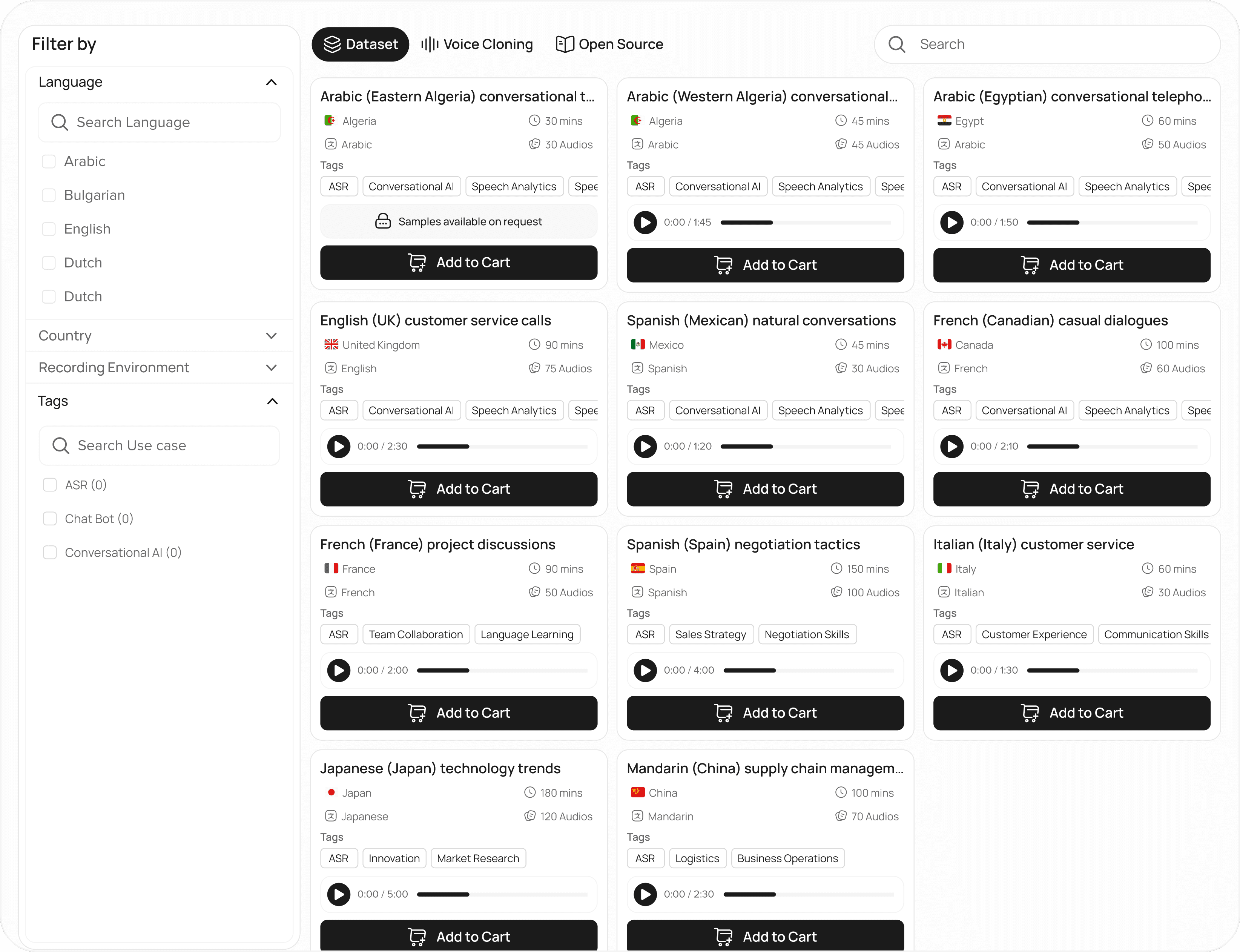
Home screen
The problem: Labs needed to scan 40+ datasets by type before they could commit to a single one. A flat list would overwhelm.
What I tried first: A category grid with large tiles.
Why this, not that: Moved to a filter-first layout with a persistent sidebar, because the research showed users filter by type and language before they browse, not after.
Dataset detail page
The problem: How do you build trust in a dataset you can't physically inspect?
What I tried first: A spec sheet format, size, language tags.
Why this, not that: Added the audio sample player inline on the page. Labs told us they need to hear it. Specs alone don't close deals.

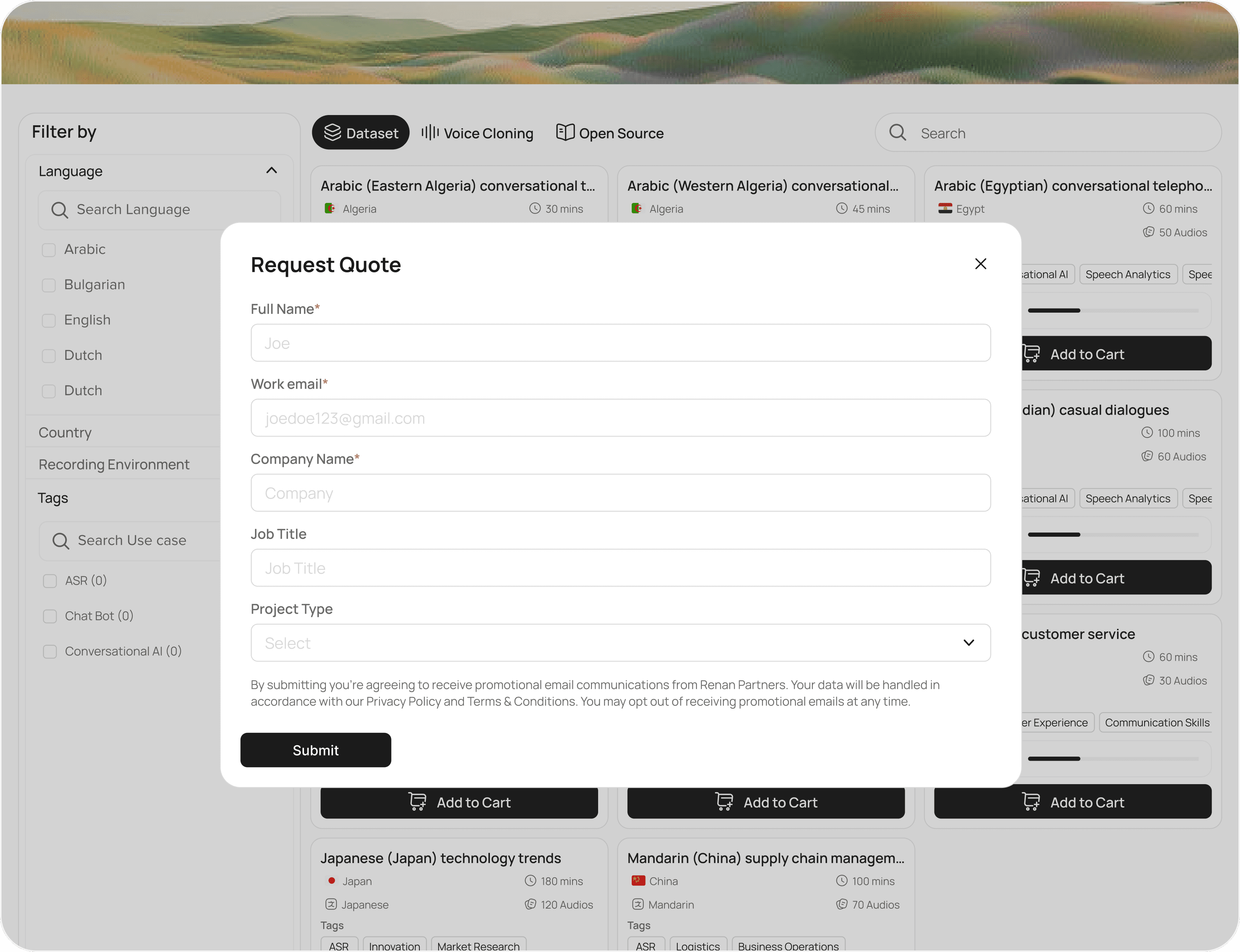
Request flow
The problem: No signup, but we still needed a conversion path.
Why this, not that: A lightweight request form, name, use case, email, that feels like a conversation, not a sales funnel.
We Didn't Just Design Faster. We Shipped Code.
01
Claude AI
Prompt the design concept layout logic, content hierarchy, component structure
02
Figma Make
Generate a working prototype from the prompt. Iterate twice without opening Figma.
03
Figma
Import the prototype, refine to pixel-perfect.
Before opening Figma, I built the first prototype entirely in Figma Make, prompted with Claude to generate the layout logic, content hierarchy, and component structure. I iterated on it twice without touching the Figma canvas. Only when the flow felt right did I import it and begin refining.
This flipped the traditional process. Instead of spending days on wireframes to communicate intent, I had a working prototype on day two that the team could actually click through. Feedback became concrete immediately , not 'I think the filter should be higher' but 'I clicked here and expected to land there.'
When the design was ready, we didn't hand off a spec. We shipped the code. The developer received production-ready components alongside the design, no redline files, no annotation decks, no back-and-forth on spacing. That single change compressed what would typically be a two-week handoff cycle into two days.
Experience the vibe-coded version: Dataset Marketplace
The Happy Path Is Easy. Here's What I Built for Everything Else.
Designing the primary flow took one week. Designing for what breaks took another. Here is what I made sure not to miss.
Empty search results: When a query returned nothing, instead of a blank screen we showed a human message and a direct 'Request a custom dataset' CTA, turning a dead end into a lead capture.
Restricted samples: Some datasets couldn't be previewed publicly. Rather than hiding them, we surfaced a placeholder state with clear context and a direct request path, so no dataset was ever invisible.
Mobile: Our primary audience uses desktop, but we designed and built the full experience mobile-first. Researchers don't always have a laptop open when a colleague shares a link.
Error states: Failed loads showed friendly recovery messages, not blank pages. Every broken state had a next step.

Live in 30 Days. Three AI Labs within a month.
30 Days
Concept to live product
40+
Proprietary datasets
3
Frontier AI lab onboarded
0
Email chains
The marketplace launched on schedule and immediately changed how Databrewery sells. The sales team stopped manually curating Excel sheets. Labs could browse the full catalogue, hear audio samples, and submit a request, all without a single email.
Within a month of launch, three frontier AI labs, Travus AI, Fano Labs, and Respeecher were using the platform to source training data for their models. Each of those relationships converted into long-term data partnerships. The marketplace didn't just replace an email workflow. It repositioned Databrewery as an AI data infrastructure platform, one that frontier labs could trust with their model quality. None of this required rebuilding what already existed. It required knowing which gap mattered most and having the discipline to build only that.
What I Got Right, What I'd Fight For More Time On
If I had 60 days instead of 30, I would have spent the extra time almost entirely in research. We moved fast, and we shipped, but the client interviews happened in parallel with early design decisions rather than before them. We got lucky that the insights reinforced the direction we'd already started. Next time, I'd protect that discovery window even if it felt like a risk to the timeline.
I'd also run at least one usability test before handoff. We shipped with confidence built on interviews and competitive benchmarking, but there's no substitute for watching someone actually use the thing. One session would have been enough to catch the friction we found in the request flow post-launch.
What I'm proud of, the pivot call. Catching the login-wall problem before we shipped, and convincing the team to restart, is the decision I'd make the same way twice. That instinct, to protect the user's first impression even at a cost to the timeline, is something I'd carry into every project.
Beyond the design work
With the marketplace live, the next challenge was getting the right people through the door. Until this point, the team's outreach had been plain context-only emails, a block of text explaining who Databrewery was, sent manually each time. There was no template, no structure, and no clear next step for the reader.
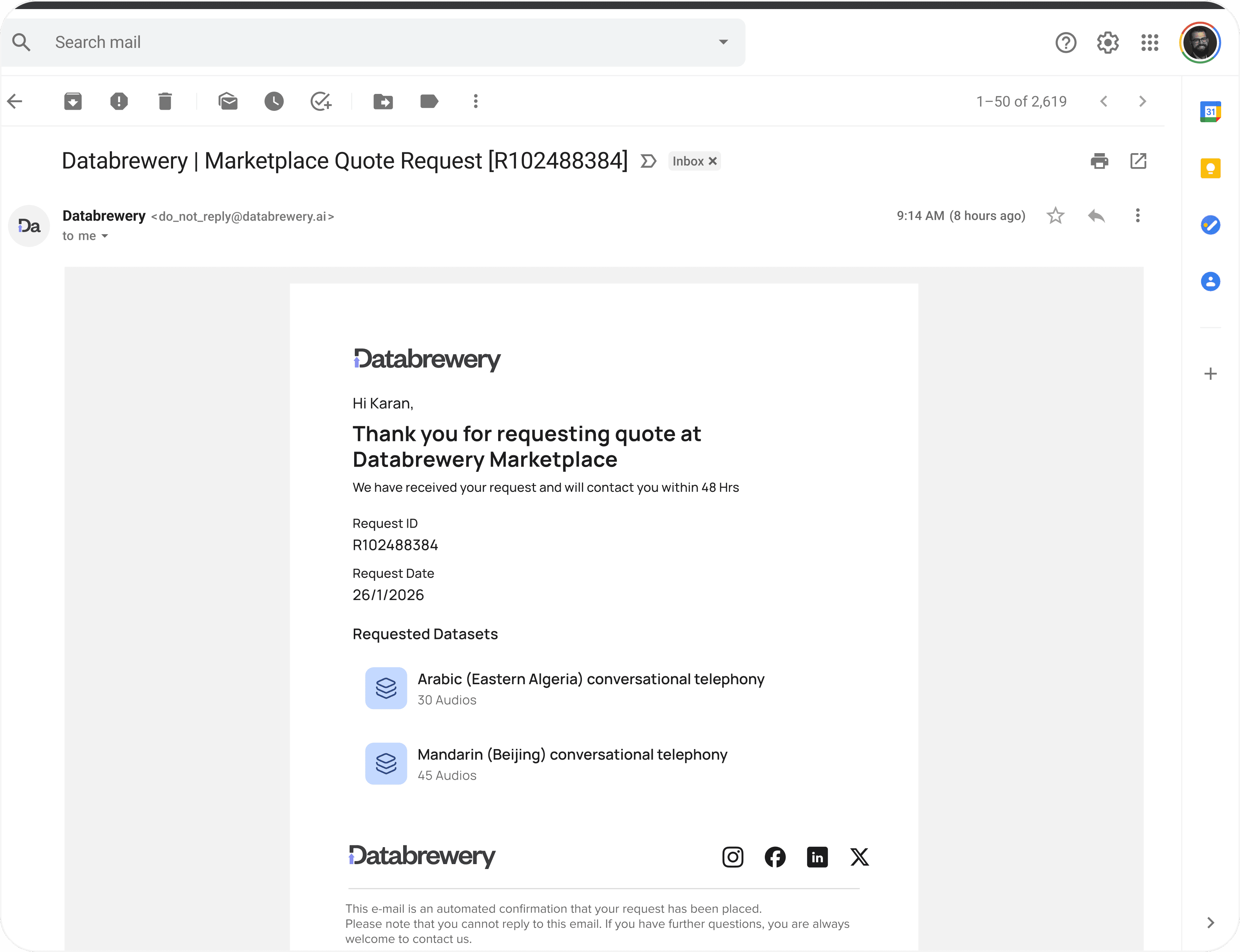
I took it on myself to build two sets of interactive email templates. The first was a cold outreach series for labs we wanted to approach proactively, structured, visually engaging, and with a clear call to action rather than just information. The second was a response template for inbound quote requests, designed to move the conversation forward quickly while still feeling considered.
These templates became the primary vehicle for announcing the marketplace launch, the first time our outreach actually looked and felt like a product worth exploring.

If this project resonates with the kind of work you're hiring for, let's have that conversation.